
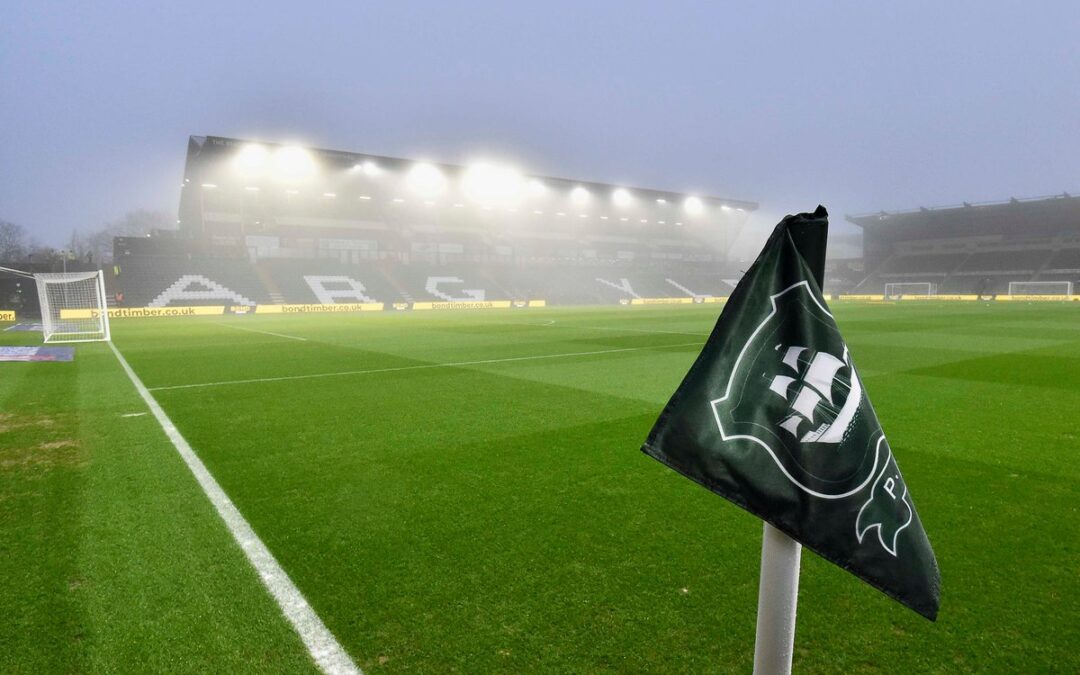
I hope you’re looking forward to the St Patrick’s Day festivities. Albeit, the celebration of the patron saint of Ireland is only set to be the third second-most important event of the day. It loses out, of course, to Plymouth Argyle aiming to keep their play-off hopes on track with a win over Stevenage.
Argyle enter this one on the back of a 2-2 draw at Reading. They didn’t get the win they craved in front of 2,900 travelling supporters, but the result was far from catastrophic for the Greens. Tom Cleverley’s side fought back from behind twice to claim a draw, the least they deserved, and the result kept them within three points of the top six. They also stopped their hosts from pulling away in the process. Job done? Not wholly, but it could’ve been a lot worse.
That game precedes two huge home games in the space of a week, against Huddersfield Town and first Stevenage. Under Alex Revell, Stevenage have just about kept themselves in the promotion hunt all season. They started phenomenally, rode out a difficult run of form, and now find themselves healthily placed in fifth, with a game in hand on many around them. Should Argyle get it, a win here would represent a significant statement of intent.
A loss at Home Park could well be fatal. And, whilst a draw would keep Argyle in the hunt for the top six, it feels like the perfect time to get another win on the board. Can Cleverley’s men do it?
The reverse fixture
1st January 2026: Stevenage 1 (James-Wildin 53’) Plymouth Argyle 1 (Boateng 68’)
There have been occasions this season where I’ve been able to run through exciting encounters from the first half of the season. Just the other day, for instance, I took great joy in recounting Argyle’s 5-1 win over Doncaster Rovers in December. Alas, this is not one of those occasions. With everyone perhaps still hungover from the New Year’s Eve festivities, Argyle and Stevenage served up a turgid encounter, with the only surprise being that any goals were scored at all.
Whilst he isn’t necessarily known for being a “tinkerman,” Revell had toyed with a few formations during the first half of the season. However, he always seemed to prefer a 4-2-3-1, and that’s exactly what we saw on this occasion. A structured shape, the idea would be to use the midfield double pivot as a solid foundation. That duo included a Green Army favourite and title winner in Jordan Houghton lining up alongside Harvey White, with Daniel Phillips ahead of them in the number 10 role.
Perhaps recognising that his squad lacks quality on paper when compared to others in the league, Revell has prioritised defensive pragmatism throughout the campaign. Significant onus was placed upon the central defensive duo – Dan Sweeney and captain Carl Piergianni – to dominate when necessary. The back four was completed by Lewis Freestone on the left and Luther James-Wildin on the right, whilst Filip Marschall edged out the familiarly named Taye Ashby-Hammond to start in goal.
With a pragmatic, direct style of play, a target man was naturally needed in the front line. That role would be played by Jamie Reid, a Northern Ireland international formerly of Torquay United, who would be trusted to be strong in the air and provide a significant goal threat. In support, Phoenix Patterson lined up on the left wing, with Jovan Malcolm on the opposite flank.
The first half was generally bereft of action. Argyle limited Stevenage to just the one shot in the first 45 minutes, and had the best chance when Mathias Ross headed wide from a Joe Ralls free kick. The closest Argyle came was actually through Ralls, as his shot from around 20 yards deflected onto the crossbar. The visitors were slightly the better side, but 0-0 was far from an egregious half time scoreline.
Unfortunately, the balance of play changed swiftly after the interval. Within eight minutes, Argyle conceded a particularly messy goal. A few deflections saw the ball fall to Patterson on the left, and he beat Malachi Boateng to put in a cross. From there, James-Wildin was somehow able to bring it down in Argyle’s six-yard box and fire home. After limiting their opponents in the first half, Argyle conceded the opening goal for the fourth game in succession.
To their credit, the Greens fought back, and got their leveller in a goal heavily impacted by substitutes. Again, it was messy. The first of those subs, Xavier Amaechi, put a free kick from the left straight into the one-man wall in front of him. From there, White stumbled over the loose ball allowing Caleb Watts, making his first appearance in almost four months, to take control. Watts picked out Boateng, who finished well first time to put the Pilgrims level.
The pendulum swung a few times from there. Lorent Tolaj had a good effort from a tight angle which Marschall saved well, before White saw a shot narrowly deflect wide at the other end. In the end, 1-1 would be the final score, and I wouldn’t say either side did enough to say they deserved to emerge victorious.
Similarities
The overriding feeling amongst those leaving the stadium on New Year’s Day was that they’d witnessed a dire game of football. That was a fair assessment. The encounter was significantly low on quality, with two messy goals providing rare highlights in what otherwise proved a snoozefest.
The bad news? I suspect we may be in for something similar on Tuesday night. Bluntly, Stevenage’s games tend to be dull. There are rarely a great number of goals at either end, and their strengths and weaknesses are still centred around them being pragmatic and functional. It’s certainly not particularly exciting to watch.
As we discussed in the preview for the reverse fixture, Stevenage don’t give up many chances. Only Lincoln City, the side best placed to be crowned champions this season, have conceded fewer goals than Revell’s men. Additionally, Stevenage have kept 13 league clean sheets this season, a total beaten only by Lincoln and Cardiff City. Clearly, defending and keeping things tight in general remains a major strength.
On the contrary, Stevenage still rank poorly in many attacking metrics. They don’t score many, and underlying data suggests they shouldn’t, with Stevenage’s xG total of 37.5 ranking a lowly 21st in the league. Additionally, they take a below-average number of shots, and only two teams have had fewer big chances than Stevenage’s 60. Granted, those stats are linked to each other, and indeed to the general style of play, but they paint a clear picture.
Across the campaign, Reid has proved an exception to Stevenage’s general attacking malaise. He didn’t get their goal in the reverse fixture, but Reid has clearly been his side’s main threat. This season, he’s scored a total of 13 league goals; Chem Campbell, who came on as a second-half substitute in the reverse fixture, is Stevenage’s second-highest league goalscorer with just four. Naturally, Reid will be a danger man on Tuesday night, and keeping him quiet will be key to Argyle’s prospects.
Overall, I think there must be an acceptance that Stevenage are overperforming against their underlying data. Indeed, whilst a draw wasn’t an egregiously unfair score on New Year’s Day, Stevenage lost the xG battle to Argyle 0.7-1.2. Currently, they’re on 57 points, sitting fifth, and well-placed to secure a place in the play-offs. However, their expected points tally is closer to 49, suggesting they ought to be sitting in mid-table, below Argyle as the season draws to a close.
As ever, that can be interpreted in many ways. Some will argue that consistently picking up results when not always playing well is a fantastic sign. Others will suggest that overperformance against underlying data cannot last forever, and it’s likely Stevenage will drop off in the coming weeks. Given they’re still up there after 36 games, I’d suggest Stevenage have the minerals to last in this race, but I certainly wouldn’t mind seeing their “luck run out” on Tuesday.
Differences
I think the most notable difference we’ll see from the reverse fixture is in Stevenage’s shape. As I alluded to earlier, whilst Revell had a preference for a 4-2-3-1, he was never inextricably tied to the shape. Nowadays, he’s gone in the exact opposite direction – Stevenage haven’t used a 4-2-3-1 for the best part of two months.
A change was made in an attempt to arrest some poor form. The 1-1 draw with Argyle was part of a run of eight league games without a win, at which point Revell opted to switch to a back three. Immediately, they beat Peterborough United and, despite then losing the next two, Stevenage have now won five of their last seven (predictably all by a single goal) by sticking with the same shape.
The 3-4-1-2 achieves a couple of objectives. First of all, it allows other centre backs to feature and make the side even more defensively secure. The likes of Lewis Freestone and Charlie Goode are solid defenders for this level, and occasionally missed out when Stevenage used a back four. At the other end, Reid has formed a strike partnership with 35-year-old Matt Phillips, with the former West Bromwich Albion man joining as a free agent last month.
I do believe that these changes have helped Stevenage at least slightly improve their attacking output. Don’t get me wrong, their underlying attacking data is still poor, but it’s heading in the right direction. Ahead of the reverse fixture, Revell’s side ranked last across the league for xG by a significant margin. These days, they’ve managed to climb above Blackpool, Rotherham United and Northampton Town into 21st. That’s not nothing.
I also want to touch on a potential discrepancy in possession. In the preview ahead of the reverse fixture, I mentioned that Stevenage had one of the lowest average possession figures in the league, which remains true. However, they had more on the day (56%), with Argyle beginning to fully embrace the idea of playing without the ball. Indeed, that’d prove a successful move in the context of their season.
I don’t suspect that’ll be the case this time around. Argyle playing at home will put the onus on them to take the game to their opponents, and the opposite will be true for Stevenage. I haven’t said it often in recent weeks, but I’d be surprised if Cleverley’s side didn’t have the lion’s share of possession.
Ultimately, we could find ourselves in a situation where neither side particularly wants to push forward. That’s a problem. Don’t get me wrong, counter attacking football can be mightily entertaining in the right conditions, and highly successful. However, this time around it seems there will be few opportunities, and barely any space, for either side to break away.
Prediction
I’m sure I’ve said enough across this piece to suggest this could be attritional. I’d be more than happy to be proved wrong, and I’d absolutely love a goalfest. But I suspect this is the sort of game where, if one team is to win, it could just take one moment to swing it either way.
I won’t rule out either side edging towards victory. However, I predicted a goalless draw ahead of the reverse fixture, and I think I’ll do the same again. 0-0.