
Hats off to anyone who is making the journey to Wycombe this Saturday. I know I won’t be. Despite the stadium being something of a namesake, one trip to Adams Park was enough for me. I don’t particularly fancy getting stuck on the one country lane to the ground again, and my matchday experience (watching John Sheridan’s side collapse in the play-offs) could be generously described as suboptimal.
I also suspect some will already be travelling in hope rather than expectation. After all, Plymouth Argyle have already lost their opening league game to an excellent Stockport County side, and comments from the board at a fans’ forum the previous day did little to allay any financial fears. The cheerful mood surrounding Home Park following a 2-0 Devon Derby win over Exeter City has been quickly extinguished.
On the pitch at least, I believe some of that has been overblown. Yes, Stockport comfortably outplayed Argyle, but it was only one game. Over time, perhaps Tom Cleverley will evolve his shape following the changes to his squad across the summer. But suggestions that he should completely rip up his favoured 4-4-2 formation on the back of one game feel a little premature, particularly after how much success it brought last season.
Nonetheless, it does bring heightened interest on Argyle’s first away game of the season. Wycombe Wanderers, like Stockport, are a team who will fancy their chances of challenging at the right end of the table this season. It’s therefore a tough and important test – how the Pilgrims perform here may give us a key indication of how they’re set to react to their early setback.
Style of play
Argyle’s experiences over the years have given us all our own perceptions of Wycombe’s style of play. Some of those still apply, whilst others are slightly outdated and stuck in our view of the Gareth Ainsworth era.
One thing has remained consistent: direct play. Wycombe are still more than happy to go long when the situation requires, with only three League One teams completing more long passes last season. They made 30 in their opening day draw with Blackpool, again ranking fourth in the division across the weekend.
The style of those long balls may depend on Wycombe’s selection up front. Stoke City loanee Emre Tezgel started the Blackpool game, and he strikes me as the sort of player who can run onto long passes into the channels and in behind. Bradley Fink, meanwhile, stands at 6 foot 4 and is much more of a target man for traditional direct football.
Last season, first under Mike Dodds and later under current manager Michael Duff, the Chairboys curated a much more patient and possession-based approach.
However, that is no longer Wycombe’s only method of attack. Last season, first under Mike Dodds and later under current manager Michael Duff, the Chairboys curated a much more patient and possession-based approach. It surprised me, for example, that Wycombe averaged 53.6% possession in the league last season, enough to rank within the top six.
My initial fear is that this makes Wycombe strikingly similar to Stockport, who were patient at times but always had a killer ball in them. Like Jimmy McNulty, Duff is no stranger to playing three at the back, and he could do so here if he aims to do exactly the same job on Argyle. However, Wycombe’s gaffer generally tends to prefer a 4-2-3-1, and I suspect that’s what we’ll see on Saturday.
My immediate thoughts go to the midfield roles. Last season Luke Leahy topped the league assist charts at Wycombe, and he’d often play alongside Aaron Morley. However, Leahy missed the first two competitive games of the season, only returning for a pizza cup tie with Reading in midweek. Meanwhile, Morley started the game against Blackpool in the number 10 position…and went off injured before half time.
As such, it’s possible we’ll see Josh Scowen alongside Ewan Henderson form the double pivot, or perhaps Caolan Boyd-Munce will slot in to allow Henderson to play a more advanced role. Out wide, last season’s top scorer Fred Onyedinma seems certain to start on the right, whilst on the left it appears to be a straight fight between summer signing Silko Thomas and Junior Quitirna.
The defence seems settled, given Duff has lined up with the same back four and ‘keeper in both the league and Carabao Cup this season. Connor Taylor forms a solid-looking central defensive duo with Steve Cook, still going strong at the age of 35. Meanwhile, Daniel Harvie has been playing at left back, with Swansea City loanee Sam Parker on the right. I wouldn’t describe them as ultra-attacking full backs, but both will be expected to overlap their wingers occasionally.
Finally, there’s the goalkeeper. Diplomatically, I’ll just touch upon Conor Hazard here and no further. Depending on your view, his form and his mindset, he could easily fall into both the strengths and weaknesses section of this piece.
Strengths
As much as this is no longer an Ainsworth side, it can still be tough to go to Adams Park. Argyle’s record there isn’t terrific, and very recent history doesn’t give the travelling Greens great hope either. Many will remember the scenes after Argyle’s FA Cup exit at the hands of Wycombe last year. It was at a time when the Cleverley era at Home Park looked doomed.
The elephant in the room here is that Argyle did win on their last visit to Adams Park, much to the surprise of Sam Down’s hair. However, it must be conceded that it was something of a smash-and-grab. It’s never this simple, and there are plenty more factors to consider, but our xG simulation (based on 100,000 simulations of the chances both sides had) put the Greens’ chances of winning that day at less than 6%.
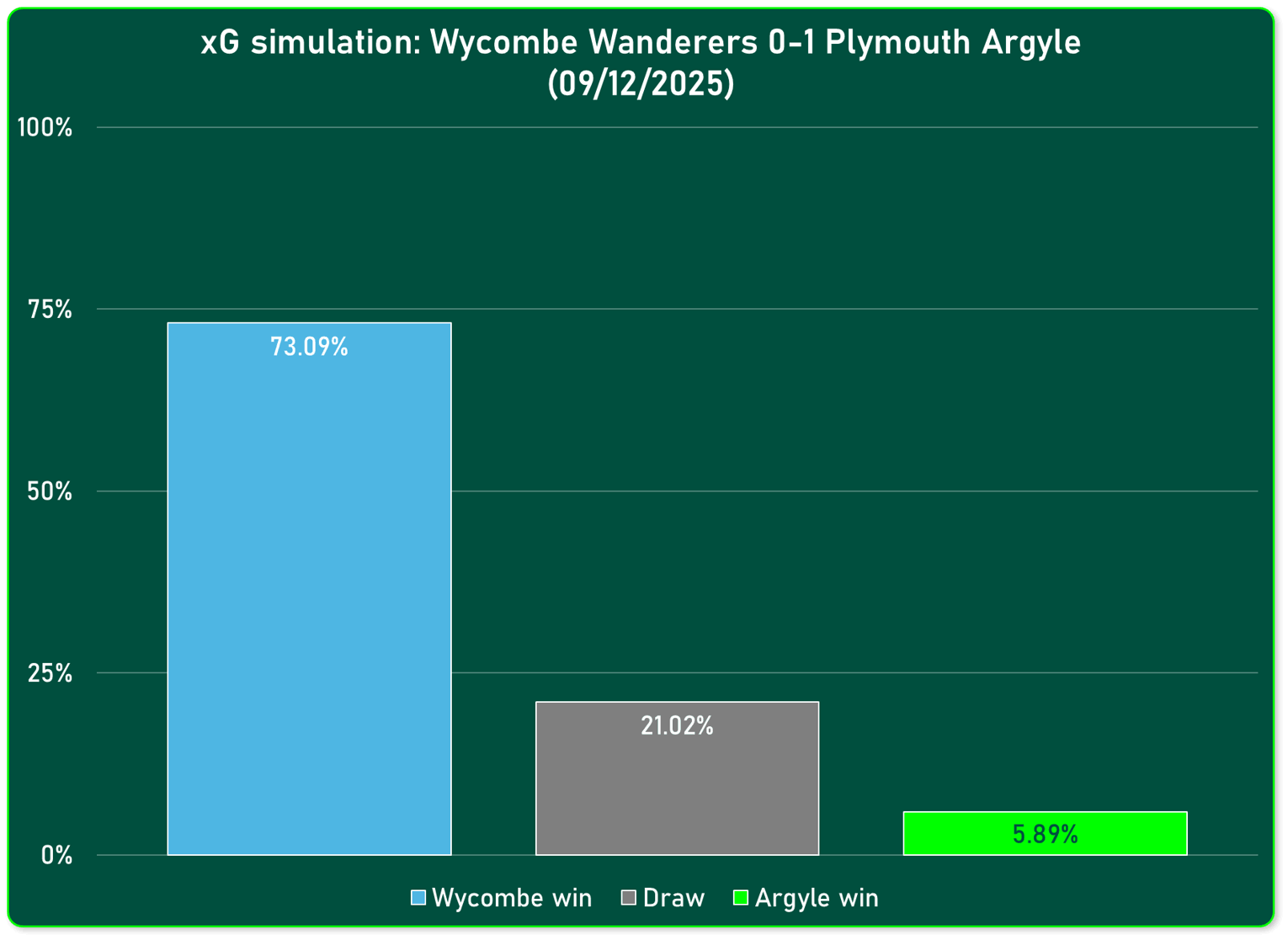
Of course, it’s important to remember that Argyle won in actuality that day. Indeed, it was one of several key away victories marking the start of Cleverley’s revival. However, it does act as evidence that Wycombe can prove difficult to contain in front of their own fans, and you’d expect them to be able to develop several chances on Saturday.
I think Duff must take plenty of credit. Good teams at this level either have outstanding individuals who can hurt any team, or come together to prove greater than the sum of their parts…and the real top teams have elements of both.
Wycombe fall into the second category. I wouldn’t say there are any true League One superstars in their ranks, at least at the moment, but Duff’s style and man management ought to be enough to have them challenging for a place in the top six.
Wycombe effectively say “we do the basics well, we do them better than you, and we’re going to win the game.”
The style he’s developed is fairly basic. I don’t necessarily say that disparagingly, given that Argyle lined up with the most basic shape of all in the second half of last season to great effect. Wycombe line up in a standard 4-2-3-1 and effectively say “we do the basics well, we do them better than you, and we’re going to win the game.” When it works, it can be tough to stop.
This all rings true in Wycombe’s attacking metrics. Crossing was a particularly potent weapon last season, with the Chairboys ranking in the league’s top six for their average of 4.9 crosses completed per game. They also ranked sixth for their number of shots on target, seventh for their total xG, and only three teams had more touches in the opposition’s penalty area than Wycombe’s 1,134.
And, as much as I said there were no standout individuals, I will add a quick word for Onyedinma. He’s technically in his fifth spell with the club, and his ten league goals was more than any Wycombe player managed last term. Additionally, his decent aerial duel success rate of 45% suggests he offers a useful wide outlet when going direct. He’s also already opened his account this season, scoring in Saturday’s draw in Blackpool.
It used to be the case that Wycombe would aim to beat you physically. These days, they’re technically and tactically proficient. Yes, Argyle will need to be up for the fight, but Cleverley must also have a strong game plan.
Weaknesses
It may sound surprising, given all the assumptions we make about Wycombe, but I don’t necessarily think they’re particularly strong defensively. That isn’t generally the case when defending set pieces; Wycombe conceded fewer goals from set pieces last season than all but one team in the League. However, from open play, Wycombe have been lacking in several key defensive metrics.
In fact, I don’t think there was a single individual defensive metric in which Wycombe ranked well last season. Their total of 337 interceptions only ranked 18th across League One. For tackles, their total of 654 ranked 22nd. Worst of all, only one team made fewer clearances in the league last season than Wycombe’s 1,280.
There is mitigation at play. Wycombe’s high average possession meant they didn’t need to do as much defending as other teams. However, that’s only part of the story, and it can’t totally negate their low rankings across the board. I’d certainly suggest the fear factor that used to surround Wycombe’s defence doesn’t exist to the same level nowadays.
Their league opener with Blackpool was a good example. The Chairboys escaped Bloomfield Road with a 1-1 draw, and “escaped” is indeed the operative word, with their hosts creating 2.37 xG on the day. It’s only one game, just like Argyle’s clash with Stockport is only one game, but it does act as an example that this Wycombe defence can be targeted, and you can certainly create chances.
No longer are they a bunch of big burly blokes who’ll look to beat you off the park. Sometimes literally.
Let’s view this through another lens: last season Wycombe committed an average of 10.5 fouls per game. Only four teams in the league committed fewer. That’s not necessarily a bad thing, but it does show how much of a change they’ve been through in recent years. No longer are they a bunch of big burly blokes who’ll look to beat you off the park. Sometimes literally.
I can scarcely believe I’m saying this, but is it possible Wycombe have become a soft touch? Too nice? I can certainly see the argument.
Away from that, I think this could well be a good time to play Wycombe. Two reasons spring to mind. First of all, it seems clear they still intend to complete significant transfer business this month; it’s widely reported that they had a bid rejected for Exeter’s Jayden Wareham this week. Wycombe’s squad could be stronger in a fortnight’s time, let alone a few months, but it doesn’t look as though any business of that nature will be done by Saturday.
Cauley Woodrow is definitely out this weekend, and could well be missing longer-term.
The second reason is on the injury front. As I mentioned earlier, Morley was substituted early against Blackpool last week. Whilst Duff has said his injury “isn’t as bad as we first feared”, it’s unlikely he’ll be back for the weekend. There’s also Cauley Woodrow, who scored both goals in Wycombe’s 2-0 FA Cup win over Argyle last season. He’s definitely out this weekend, and could well be missing longer-term.
Wycombe are likely to be tough to beat this season. The opportunity to do so early, before additional strengthening and the return of some absentees, shouldn’t be taken lightly.
Prediction
Despite Wycombe’s less than ideal defensive numbers, Argyle don’t score many here. Their pattern of goalscoring in recent games at Adams Park is 1, 0, 1, 0, 0, 1. Scoring has been binary for the last six matches, and Argyle haven’t netted twice in a game in these parts for 11 years.
The omens, therefore, would suggest that Argyle will need to keep a clean sheet to secure a victory here. That’s not impossible, but I suspect Wycombe have it in them to score at least once. And, whilst I’d stress that Wycombe’s strengths mean it won’t necessarily be time to panic, I do have them down as the more likely winners.
Wycombe Wanderers 2-1 Plymouth Argyle
We are proud to be working with Children’s Hospice South West (CHSW) as Argyle Life’s Official Charity Partner for the 2026/27 season. You can learn more about CHSW’s work by clicking here, and supporters who would like to make a contribution can do so via our JustGiving page.